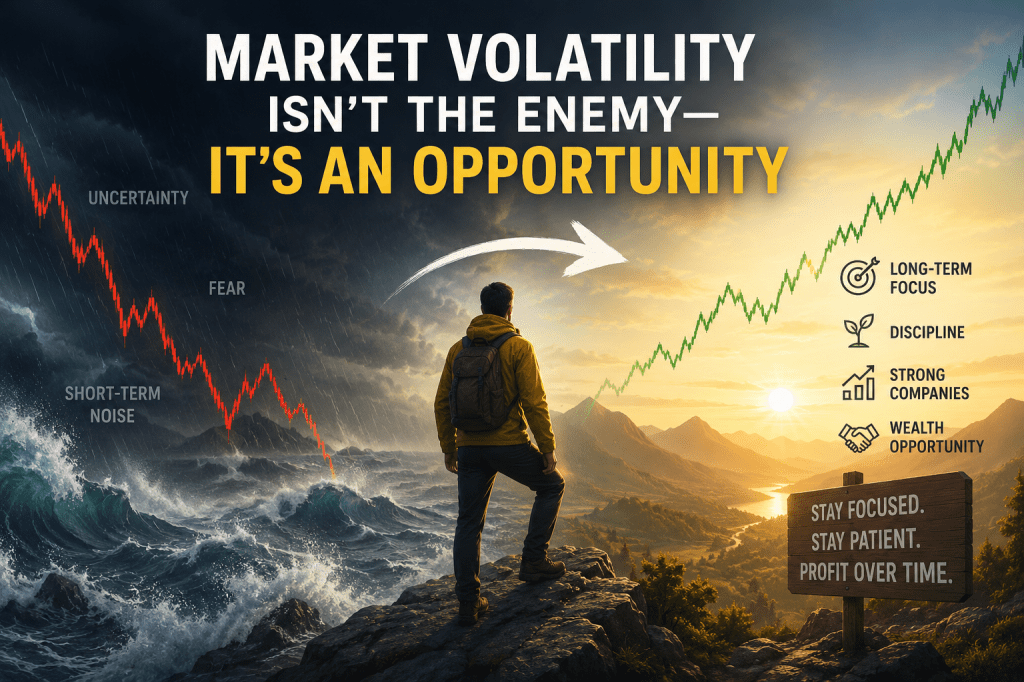
Staying Focused When Markets Become Uncertain
Recent market movements have reminded investors that volatility is a natural part of the investment journey. One day markets respond positively to economic data, while the next they react to interest rate decisions, inflation reports, or geopolitical developments.
During times like these, it’s common to wonder whether it’s better to wait for the markets to settle before investing. In reality, uncertainty has always been part of investing, and history suggests that periods of volatility often create opportunities for those who remain disciplined.
Understanding Market Volatility
Market volatility refers to the fluctuations in the prices of financial assets over time. These movements are influenced by a range of factors, including:
- Interest rate decisions
- Inflation trends
- Corporate earnings
- Economic data releases
- Geopolitical events
- Currency movements
While short-term price swings may seem concerning, they are often driven by changing expectations rather than a permanent decline in the value of quality investments.
Avoid Emotional Investment Decisions
One of the greatest challenges during volatile markets is managing emotions.
Fear can encourage investors to sell after prices have fallen, while optimism can lead to buying after prices have already risen. Both reactions can negatively impact long-term returns.
A disciplined investment strategy is built around financial goals and long-term planning—not short-term headlines.
Why Volatility Can Create Opportunities
Market downturns don’t only bring risk; they can also present opportunities.
When markets decline, fundamentally strong companies may become available at more attractive valuations. Rather than attempting to predict the perfect entry point, maintaining a consistent investment approach can help investors benefit from opportunities as they arise.
This is why long-term investors often focus on staying invested instead of trying to time the market.
The Importance of Diversification
No single investment performs well in every market environment.
A diversified portfolio that includes different asset classes, sectors, and regions can help reduce overall risk while providing exposure to long-term growth opportunities.
Diversification doesn’t eliminate market risk, but it can improve resilience during periods of uncertainty.
Focus on What Matters Most
Instead of reacting to daily market movements, it’s more productive to focus on factors that contribute to long-term investment success:
- A well-diversified portfolio
- Consistent investing
- High-quality businesses with strong fundamentals
- Regular portfolio reviews
- A long-term financial perspective
These principles have remained effective across different market cycles.
Looking Beyond Short-Term Noise
Today’s markets continue to be influenced by interest rate expectations, inflation, technological innovation, and global economic developments.
While these factors contribute to short-term volatility, they also create new opportunities across various sectors and asset classes. Remaining informed while avoiding emotional decisions is often the best approach during uncertain periods.
Final Thoughts
Volatility is not a sign that investing has become impossible—it’s a reminder that markets naturally move through periods of optimism and uncertainty.
Long-term success is rarely achieved by reacting to every headline or trying to predict every market movement. Instead, it comes from maintaining a disciplined investment strategy, staying focused on long-term objectives, and making thoughtful decisions based on sound financial principles.
In investing, patience, consistency, and a clear strategy often prove to be the greatest advantages.


 Sam George insight!