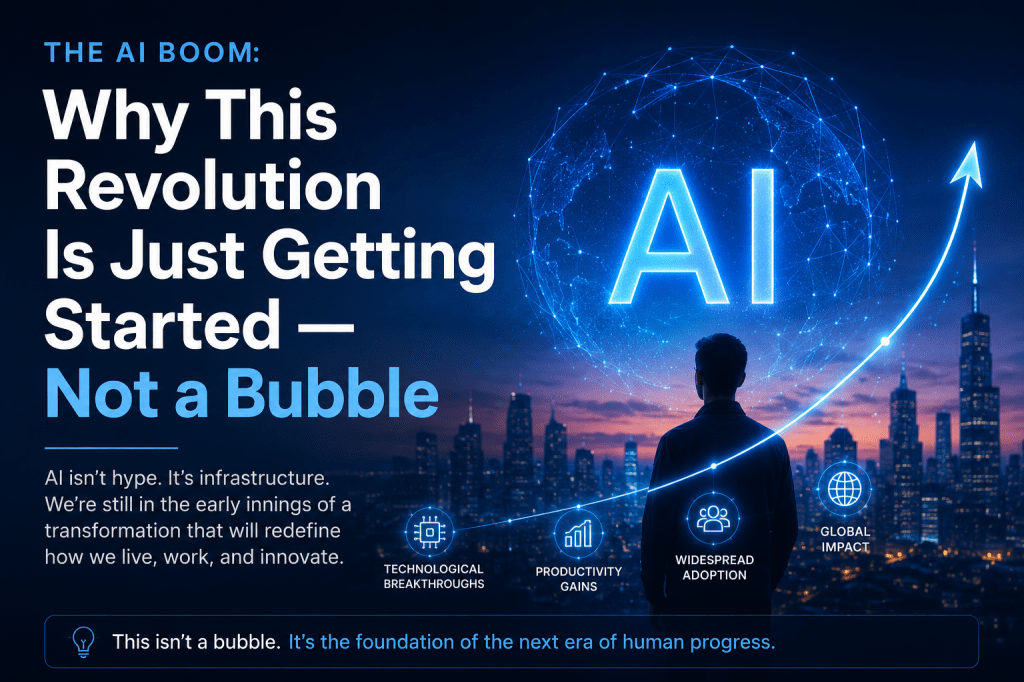
Artificial intelligence (AI) stands at the center of one of the most transformative shifts of our lifetime.
Many skeptics are calling it “the next bubble.” But after analyzing the fundamentals, the adoption curve, and the flow of global capital — I’m convinced the AI boom is only just beginning.
We’re not witnessing a speculative frenzy; we’re witnessing the foundation of a multi-trillion-dollar industry that will redefine how the world works.
Unlike the speculative dot-com era, today’s AI leaders are generating record profits and driving tangible productivity gains.
- Infrastructure investment is exploding — companies like Nvidia, AMD, and Microsoft are powering the digital backbone of the AI economy with chips, cloud infrastructure, and advanced data centers.
- Revenue is scaling, not shrinking. Nvidia recently surpassed $5 trillion in valuation, backed by earnings growth that matches — not exaggerates — investor expectations.
- AI adoption is happening across every industry: healthcare, banking, logistics, retail, manufacturing, and cybersecurity.
These aren’t hype cycles — they’re revenue engines. And when real innovation meets real profitability, you don’t have a bubble. You have the start of a transformation.
Despite the media buzz, most of the world has barely started adopting AI in full scale.
Think of the Internet in 1998 — promising, powerful, but still primitive. That’s where AI stands today.
- Over 70% of global enterprises are still in early-stage AI deployment.
- Governments are beginning to integrate AI into defence, healthcare, and public infrastructure.
- Entire industries — agriculture, energy, education — are just now realising AI’s efficiency potential.
The true returns for investors come not when everyone is using the technology, but when adoption accelerates.
We’re on the cusp of that acceleration phase right now.
One of the strongest arguments for the AI boom is its measurable economic impact.
AI isn’t just a new product — it’s a productivity revolution.
According to McKinsey, AI could add $15–20 trillion to global GDP by 2030. That’s more than the combined economies of Japan and Germany.
We’re already seeing it:
- AI-driven automation is saving Fortune 500 companies millions annually.
- AI analytics is improving logistics, cutting waste, and boosting output.
- In finance, AI is reducing fraud, improving forecasting, and enhancing risk management.
This isn’t speculative enthusiasm — this is productivity-driven growth, the single most sustainable form of economic expansion.
As an advisor, I often remind clients: Don’t just chase the gold rush — own the picks and shovels.
In the AI revolution, those “picks and shovels” are:
- Semiconductors (Nvidia, TSMC, AMD) — powering every AI model.
- Cloud computing (Microsoft Azure, Amazon AWS, Google Cloud) — hosting the data and models that drive AI.
- Data infrastructure and cybersecurity — ensuring AI systems are efficient and protected.
These companies aren’t speculative bets. They’re the foundation of the AI ecosystem — with consistent earnings, strong cash flows, and global market dominance.
That’s not what bubbles are made of; that’s what long-term wealth is built on.
The skeptics draw comparisons to the dot-com crash. But as an advisor who’s studied those market dynamics closely, here’s why this time is different:
| Then (Dot-Com 1999) | Now (AI 2025) |
|---|---|
| Companies had no profits | AI leaders generate billions in profit |
| Internet adoption <20% | AI adoption rising across 80% of Fortune 500 |
| Infrastructure immature | Infrastructure already global-scale |
| Speculative IPOs | Disciplined capital, proven revenue models |
In short — the foundation is stronger, the adoption broader, and the monetisation clearer.
This isn’t a speculative sprint. It’s a marathon of innovation that’s reshaping every layer of the economy.
Here’s how I guide clients who want to participate in this long-term trend responsibly:
- Think in decades, not months.
True technological revolutions compound over years, not quarters. - Diversify intelligently.
Balance exposure between AI infrastructure (chips, cloud) and applications (enterprise, robotics, biotech). - Prioritise quality.
Invest in companies with strong cash flow, innovation pipelines, and proven execution — not hype-driven names. - Stay invested.
Market pullbacks will happen. But history shows: those who stay invested through innovation cycles reap the highest rewards.
AI isn’t replacing human potential — it’s amplifying it. From curing diseases to optimising economies, it’s the next great driver of productivity and prosperity.
The market enthusiasm isn’t irrational; it’s a reflection of the extraordinary opportunity ahead.
In my view, we’re not witnessing a bubble inflating — we’re watching a foundation being built.
For investors who position early, wisely, and with discipline, this could be the defining investment theme of the next decade.
As your financial advisor, my conviction is clear:
The AI boom isn’t a fad. It’s the framework for the future.
Yes, there will be volatility. But revolutions aren’t measured in weeks or months — they’re measured in decades.
Those who recognise that now won’t just witness the next great technological era — they’ll profit from it.



 Sam George insight!